Shimoni Village History
Shimoni was also the original headquarters of the Imperial East Africa Company, in the years before Kenya even became a British Colony. Immediately opposite to the entrance of the cave, are the remains of the old headquarters building. It later became the District Commissioner’s House in Colonial times. This Building is one of the earliest buildings to be erected by Europeans in East Africa. Rumor has it from a good source that the national museums of Kenya has a master plan to clean up the Shimoni sea front and the old ruin will be a centre piece for visitors.
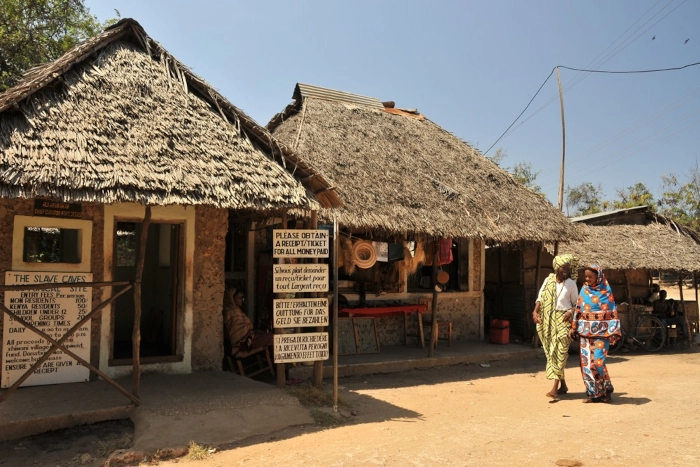
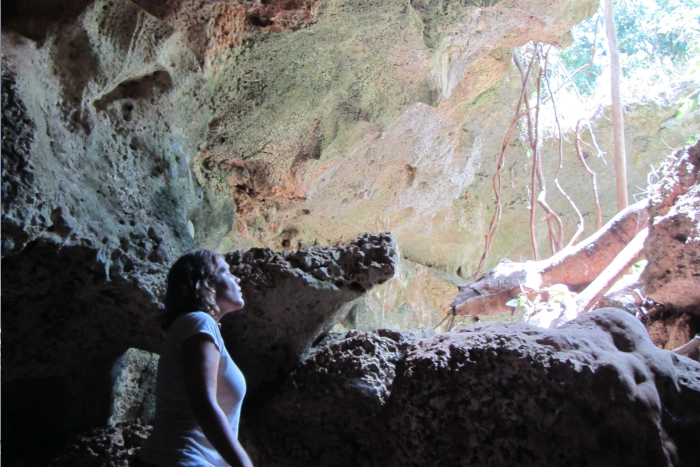
Shimoni Slave Caves
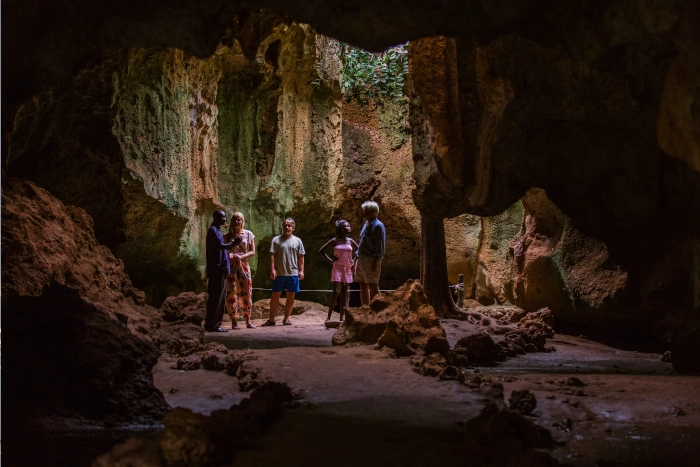
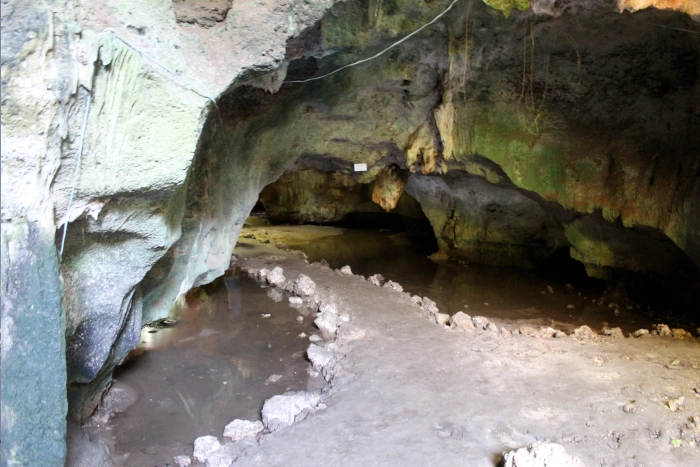
Shimoni in Swahili means ‘The place of the cave’. Shimoni Caves are a fascinating historical site and were formerly used as “Kayas” – shrines and as a hiding place for the native people who hid from attacks by marauding tribes from the hinterland. Dank and dark, they would have been well hidden here.
Formed millions of years ago by coral polyps under the sea, there are several caves once joined together and believed to extend some 5 kilometres inland.
is almost certain that Arabs used these caves as a pen to hold slaves pending the arrival of ships to transfer them to Zanzibar. Reports of old, rusty chains found in the cave lend credence to this belief.
Thus the caves have a grisly history, which inspired the song “Shimoni” by renowned Kenya-born singer, Rodger Whittaker who recorded it in these very caves.
In his song, Whittaker imagines that the voices of the dead slaves are calling to him from the walls of the caves.
“Listen as a million slaves tell you
how they walked so far,
how many died in misery, while the rest
were sold in Zanzibar”
Maybe, if you stop and listen in the silence, you too will hear them, for these caves must have seen so much human agony.
Ironically By visiting the caves ,, you have helped in efforts to earn money for much needed development in Shimoni and in turn change the caves into positive happiness giving community support.
Shimoni Forest
A network of nature trails crisscross the eastern part of the virgin coral rag forest that covers about 70% of the shimoni forest area.
The bedrock of the island is made up of an impressive substrate of fossilized coral. You can still see the skeletal structures of corals and giant clams – a gentle reminder of the passage of time. More staggering still is the coral-rag forest. You would be forgiven for thinking it a rainforest at first, before closer inspection reveals that in Shimoni a highly specialised plant community has developed that survives without any groundwater. The dense canopy keeps the scorching sun out of the forest where aerial roots tangle and compete to form the incredibly dense matrix of this special forest habitat. To watch out for: the birds hiding in the thicket. Our bird list consists of 64 species including the Mangrove and Pied Kingfishers, Fish Eagle brown headed parrot and many more.
The hermit crabs that busy about searching for new shells to adopt as their homes. Notice the early morning mosaic of trails across the sand where they have been exploring the beach while you sleep.
Observe the rare giant Coconut Crabs (Birgus latro). They can reach up to 45 cm in diameter!! These magnificent invertebrates roam about at night and are able to climb palm trees to reach their sought-after coconuts.
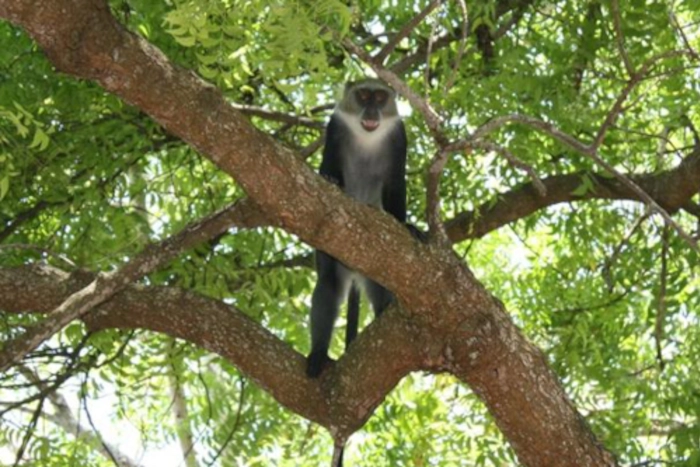
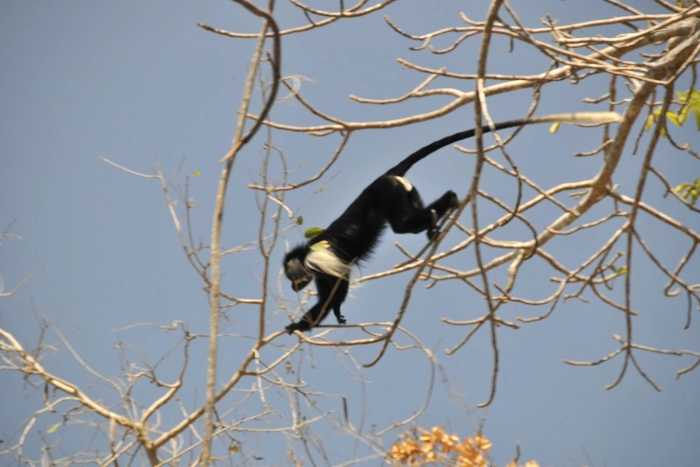
The 3 species of monkeys, including baboons, sykes, and most amazing is the rare Colobus monkey. Shimoni is one of only 3 locations left in east Africa to see the Angolan colobus monkey in the wild.
Giant baobab trees, hundreds of years old. One such tree took 12 people with their hands help out to go all around.
Entrance ticket: Ksh 400
Flora and Fauna in the Shimoni Forest
Elephant Shrew This unique shrew eats invertebrates (particularly ants) found in leaf litter and has been declared rare by the IUCN.
Suni are small forest antelopes only 40cm tall although the male’s horns can reach 13cm. They feed in short bursts interspersed with rests and are most active after rainstorms and around dusk and dawn. They rest during the heat of the day.
Mongooses These primarily terrestrial predators eat invertebrates, small vertebrates and sometimes fruit. Most species are water dependant inhabitants of forests, woodlands, savannahs and marshes; however, some can go long periods without water. Mongooses likely to be seen are the Egyptian mongoose, slender mongoose, white-tailed mongoose and bushy tailed mongoose.
Genets and Civets Genets and civets are to carnivores what lemurs are to the higher primates. Civets, in particular, are modern approximations of all carnivores’ common ancestral stock. They are almost entirely terrestrial, solitary foragers and not endangered.
Bats There are two types of bats in — insect eaters (insectivores) and fruit eaters (frugivores).
African Hedgehogs (Atelier) The evolution of spiny armor has been a major factor in these hedgehogs’ survival as a group. They are successful and widespread modern survivors of a very ancient group.
Bush pigs (Potamochoerus larvatus) Bush pigs range across Kenya up to 4000 metres on Mt. Kilimanjaro and live in forest and woodland habitats. They are omnivorous – eating roots, tubers, bulbs, fruits, larvae, beetles, snails, amphibians and reptiles.
Butterflies There is an array of brightly colored butterflies found in the area.
Coastal giant millipede This is the largest of the giant millipedes reaching over 10cm.
Owls Their eyes can see in dim light (but not in total darkness), and they have the best hearing of all birds. They eat mice and rats.
Silvery-Cheeked Hornbill This striking, large bird is at home in Diani and forests, parks and gardens along the Kenyan South Coast and as far as Nairobi.
Strangler figs Strangler figs are plants known as epiphytes (plants that start by growing on other plants). Researchers have postulated that this epiphytic habit is an adaptation to avoid fire and being foraged on by herbivores.
Baobab Truly a tree that represents Africa, this striking deciduous tree of immense girth grows up to 25 meters in height. It is bare of leaves up to 9 months of the year, leaving immense bare branches, earning the baobab the nick-name “the upside down tree”.
Neem Tree This tree is common on the coast, though it is not indigenous to Africa. It is a hardy tree which grows up to 118 meters. It has a rough, pale brown-grey bark, small, glossy-green compounded leaves, small white or cream-colored fragrant flowers and small oval, greenish-yellow berries. It is widely planted on the coast for fuel, timber, shade, agro forestry in exhausted soils, and as traditional medicine for treating 40 diseases, including malaria. It is also used for soap making. Colobus like to eat its leaves while its berries are a favourite for sykes and vervets.
Angolan Black and White Colobus
The Angolan black and white Colobus monkey has black hair with a white brow band, cheeks, and throat. Long haired white epaulettes stream from the shoulders. The lower part of the tail is white as is the band on the buttocks. This subspecies, the palliatus, can only be found in the southern Kenyan coastal forests and the northern Tanzanian highlands. Although the palliatus were previously found along the entire coast, deforestation in the northern parts have resulted in their restriction to isolated pockets of forests south of Mombasa. Travelling further inland, the Guereza black and white Colobus occur. These are much bigger, have longer coats, have a full cape of white hair around their backs and full bushy white tail. Colobus eat mostly leaves (and some fruits and flowers), have no cheek pouches, are arboreal (live in the tree canopy and rarely come down to the ground) and have a light-weight bone structure and elongated limbs – making it easier to leap from branch to branch.
Infants are born strikingly white, and then turn grey and black and then by three months of age, to the adult colouration of black and white. They are born throughout the year but a birth peak is seen in September and October.
Sykes Monkey
Sykes Monkey, also known as the White throated Monkey or Samango monkey, is an Old World monkey found between Ethiopia and South Africa, including south and east Democratic Republic of Congo. It has been considered conspecific with the Blue Monkey but has a large white patch on the throat and upper chest, and a grizzled cap.